
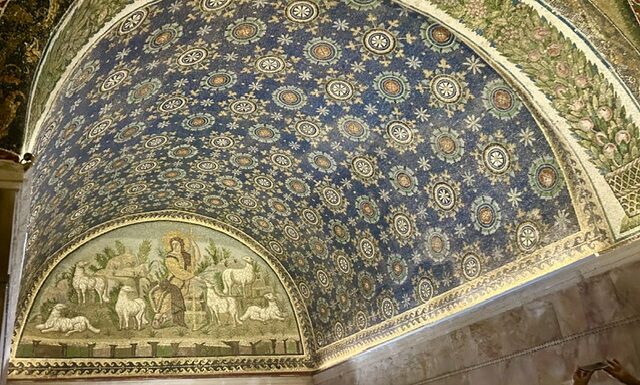
You’ll never forget those moments in Italian travel, when you step inside a doorway and get struck with such beauty, that your heart skips a beat…you catch your breath, tears come….
That was my experience in Ravenna last spring, walking into the Basilica di Sant’Apollinare Nuovo…
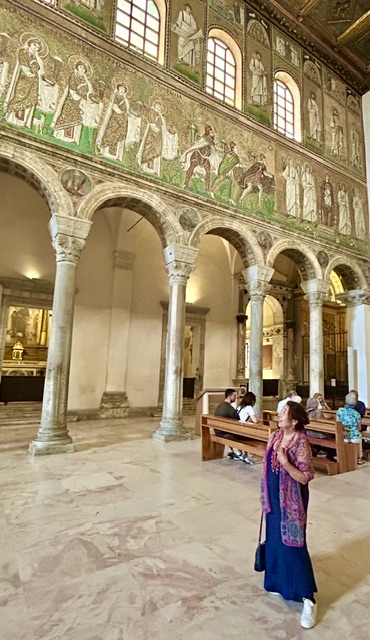
Here is one of Ravenna’s many masterpieces, created in the fifth and sixth centuries. This is when the town, thanks to its position on the northern Adriatic coast, became a powerful port and trading center. While Rome was being sacked and the Western Roman Empire fell, Ravenna flourished, becoming a cultural center of the Byzantine Empire. It was a turning point in European history — showcased in Ravenna’s mosaics — that blend Greek, Roman and Christian iconography with oriental and western styles.
Eight monuments make up Ravenna’s UNESCO World Heritage Site — a minimum 2-day visit would be best to take it all in, enjoy the art and the town — lovely piazzas, pedestrian only historic center, and few tourist crowds. An ideal place to blend in with the locals is Il Mercato Coperto–an enclosed market, that was formerly a Liberty style stock exchange building from 1922, now stylishly renovated to house a mix of colorful produce stalls, bakeries, bar, and restaurants. Concerts, culinary demos, and book presentations pop up there, adding to the fun.
We were based in Rimini, about an hour’s drive away, so had a free morning to explore 3 of the monuments with our excellent guide Alessandra. Moving along, my imagination was fired up, imagining the mix of crews that worked together to create these beauties. In the Basilica San Vitale, an oddly octoganally shaped church, the sixth century Emperor Justinian and his wife Theodora are featured in mosaics above the altar, side-by-side with holy figures. Justinian was known as the “Emperor who never sleeps”–ambitiously expanding Roman territory into North Africa. As always, I was drawn to the female figure, Theodora, a former showgirl, who by Justinian’s side commissioned the building of the Hagia Sophia in Constantinople, renowned for its mosaics. Theodora was also a fighter for women’s rights, inspiring laws to protect prostitutes and improve divorce rights.
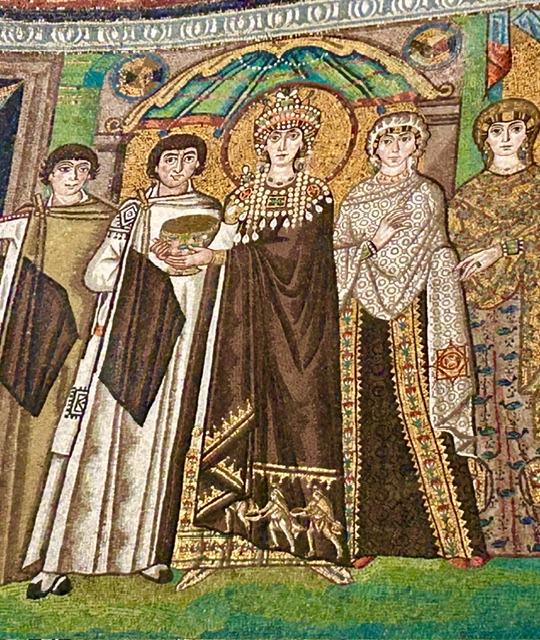
When Gustav Klimt saw San Vitale in 1903, he was inspired to begin his “Gold Period” and create such masterpieces as “The Kiss”.
The dazzling carried on in the Mausoleum of Galla Placida — a glowing Garden of Eden, starlit sky, alabaster windows — dedicated to the daughter of a 5th century Roman Emperor.
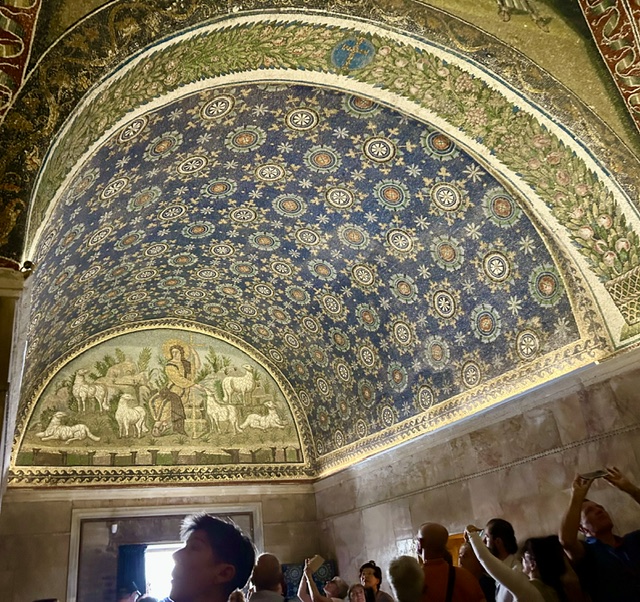
It was quiet in there, all of us looking up, humbled.
********************************
SHOPPING – Dimensione Mosaico, Via Posolini 19 (www.dimensione-mosaico@libero.net)
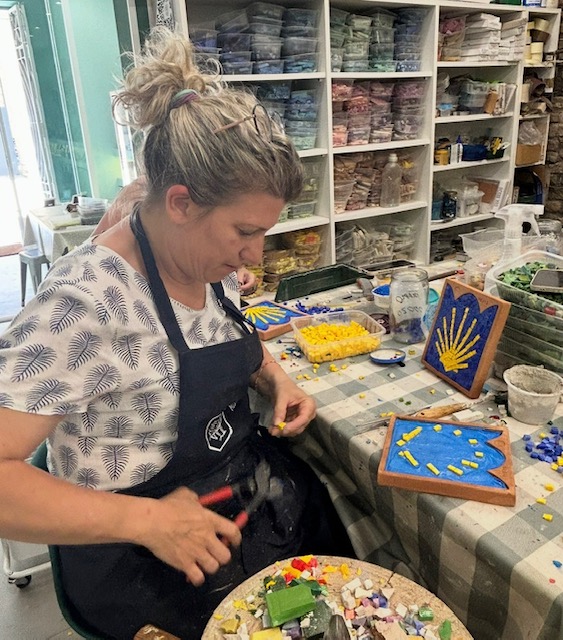
A good selection of jewelry, plus a back room where mosaic workshops are offered.
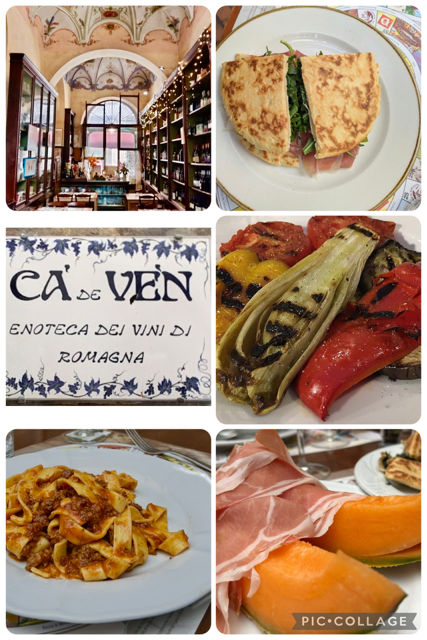
LUNCH — At Ca’ de Ven, www.cadeven.it, a former 15th century palazzo, was a lively local scene, with excellent specialties of the area–Piadina (thin flatbread stuffed with spinach and the local soft squacquerone cheese), perfectly ripe melon and proscuitto, tagliatelle Bolognese, and the outstanding red wine–Sangiovese Romana.
GUIDE – Alessandra Broccoli, www.emiliaromagnaguide.com, absolutely enriched our experience–bringing passion and expertise every step of the way.